Rest in Paradise - David Hockney (1937-2026)
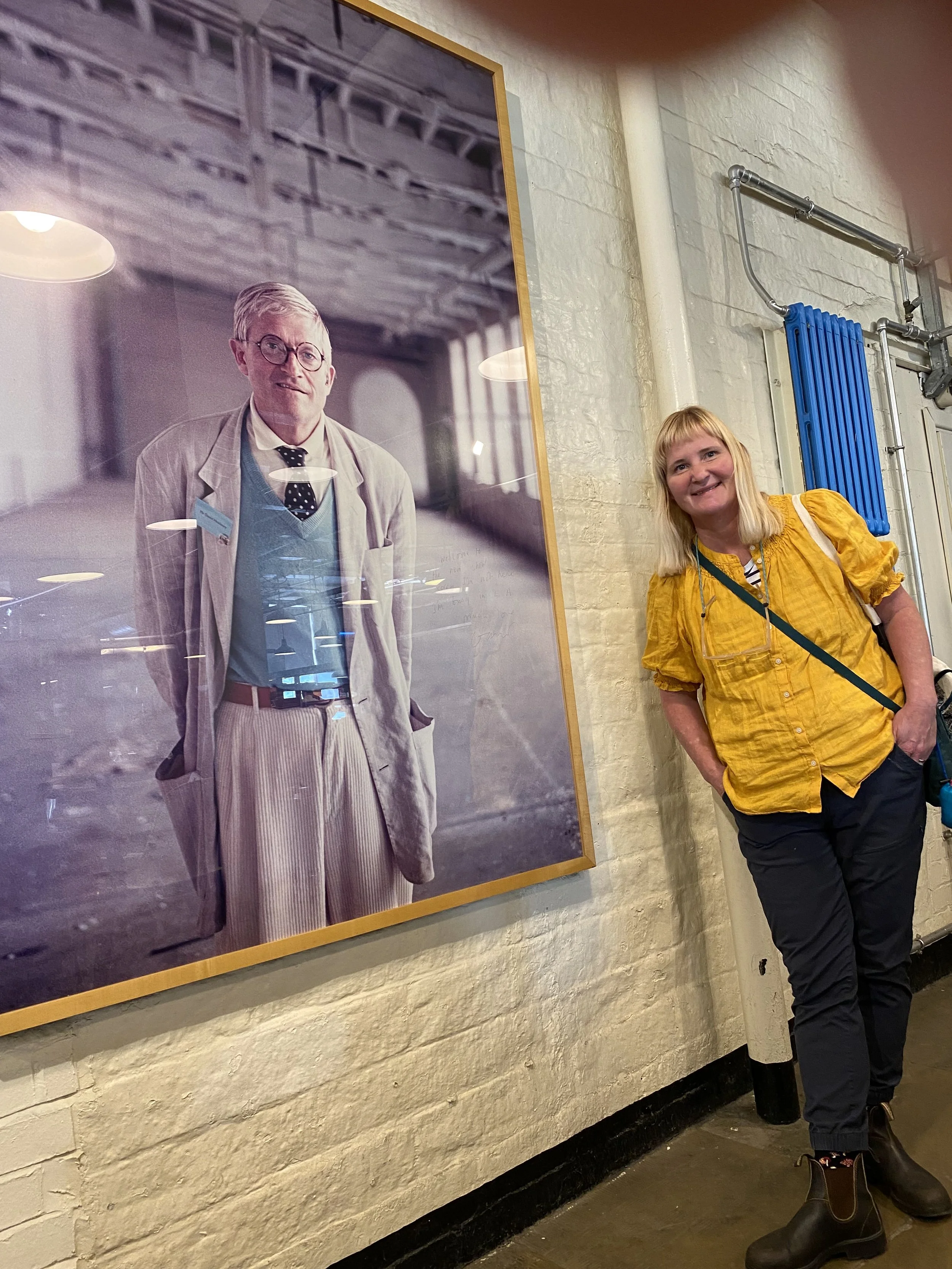
David Hockney Museum. Salts Mill, Saltaire, Bradford, Yorkshire, UK. 2023
Profound sadness swept over me on June 12th, 2026 when I woke up to the early news that David Hockney had died peacefully in his sleep one month short of his 89th birthday. It was a grief felt as if someone I knew deeply, closely had slipped off this mortal coil. It was a grief felt by many artists, in my generation in particular, who have grown up alongside his paintings, collages, photographic joiners, etchings, drawings, moving pictures, faxed drawings, iPad paintings and stage sets. The realization hit me, that we were now alone, in a world that would no longer bear fruit of a new Hockney body of work to dazzle, inspire and delight the senses.
He was a familiar, gentle, kind, pithy, funny and authentic Yorkshire man whose artistic style and vision provided a respite and contrast to the often deranged, exclusive and complicated contemporary art world. He was incredibly popular with all ages from all walks of life. As his prominence and success grew, he remained humble, witty and approachable. His voice reached out over the gatekeepers of Artland to younger aspiring artists, like myself, struggling away in small rooms with their craft, unheard, unknown, striving, confused and rejected. He spoke to them. Made them believe that art was a noble pursuit and a worthwhile destiny. That spending time engaged with being, looking, experiencing life at an intrinsic level and translating personal experiences into something artistically interesting would be time well spent.
“I paint what I want, When I want” D. Hockney
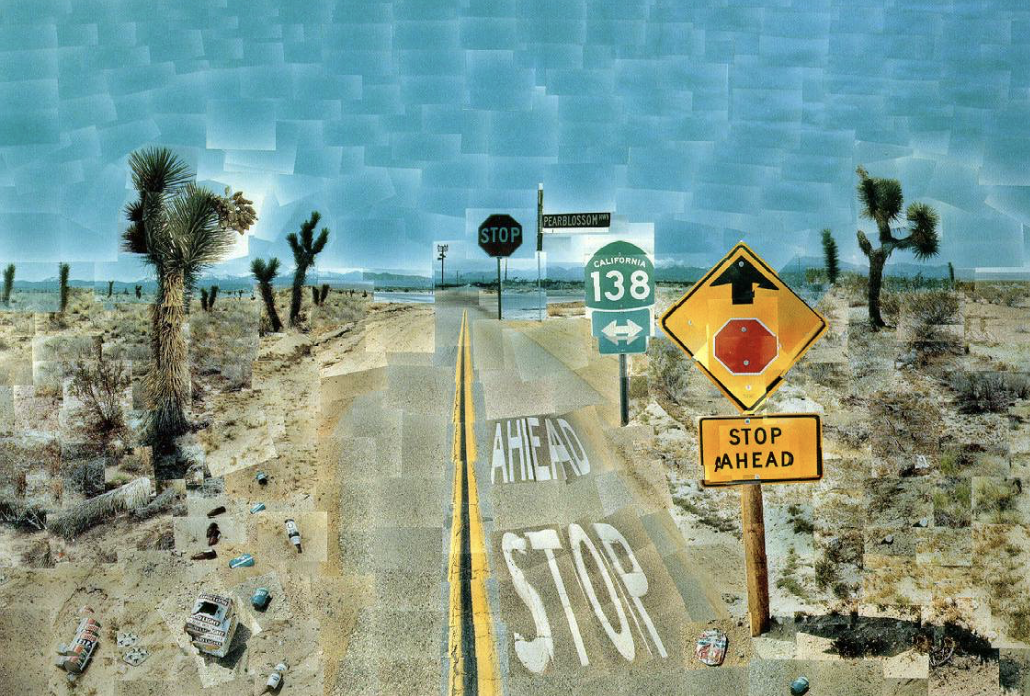
Pearblossom Highway, 11-18th April 1986 #2 (1986) by David Hockney
Image credit: The Hockney Foundation. In the Collection of the Getty Museum, Los Angeles, CA.
I had heard of Hockney when I was a teen learning about art in school in the UK. I was born the next town over from him which I think peaked my interest initially. But, it wasn’t until I had moved to Los Angeles in the 1990s as a twenty five year old aspiring creative type, that I first saw a large body of his work at LACMA (Los Angeles County Museum of Art). Hockney was living in LA and producing his new Photographic Joiners. His show at the LACMA showed portraits of his parents, collegues, peers and friends, the pool paintings and the new Photographic Joiners. There was one in particularly that stopped me dead in my tracks, “Pearblossom Highway” I was captivated by something I had never seen before and that was Hockney’s magic.
The 90s was a moment in art when digital art, photography, video art and new media were declared to be the next great thing that would end painting for good. Hockney put this theory to the test. Experimenting with ways to push the limits of lens based imagery to see if it could indeed replace painting. I’m glad to say, after many years of trying, he discovered that none of the new media could come close to the sensation of painting. I agreed, but his “Pearblossom Highway” and other photographic joiners, came very close I thought. Capturing that sensation of “walking” through space with your eyes much like painting.
About Pearblossom Highway, 11-18th April 1986 #2
David Hockney’s ‘Pearblossom Highway, 11-18th April 1986, #2’ is a photographic collage that chronicles his road trip on a California highway, CA 138. The artwork is composed of 750 color photographs, offering both the driver’s and passenger’s perspective of their journey. Hockney’s photography experiments sought to shatter conventional perspectives by creating immersive artworks that gave the viewer alternative ways of seeing.
The image reveals a seemingly mundane scene of a highway with desert vegetation but in Hockney’s interpretation becomes an exciting and vibrant artistic creation. His decision to use hundreds of photos offers the viewer multiple viewpoints by disrupting traditional camera angles; this creates an unusual experience for viewers accustomed to seeing only one fixed angle.
(Source: LACMA)
After seeing the LACMA exhibition, I was hooked on Hockney. He was revolutionizing painting and evolving Picasso’s cubist ideas of time through space. Matisse’s palette and shapes. Bending spatial compositions to relate to the way we experience moving through a landscape - with our eyes. Another favorite piece from his 80s-90s era, “Mulholland Drive: The Road to the Studio, 1980” . What interested me most was how he played with perspective. How he challenged perspective. How these paintings took you on a road trip.
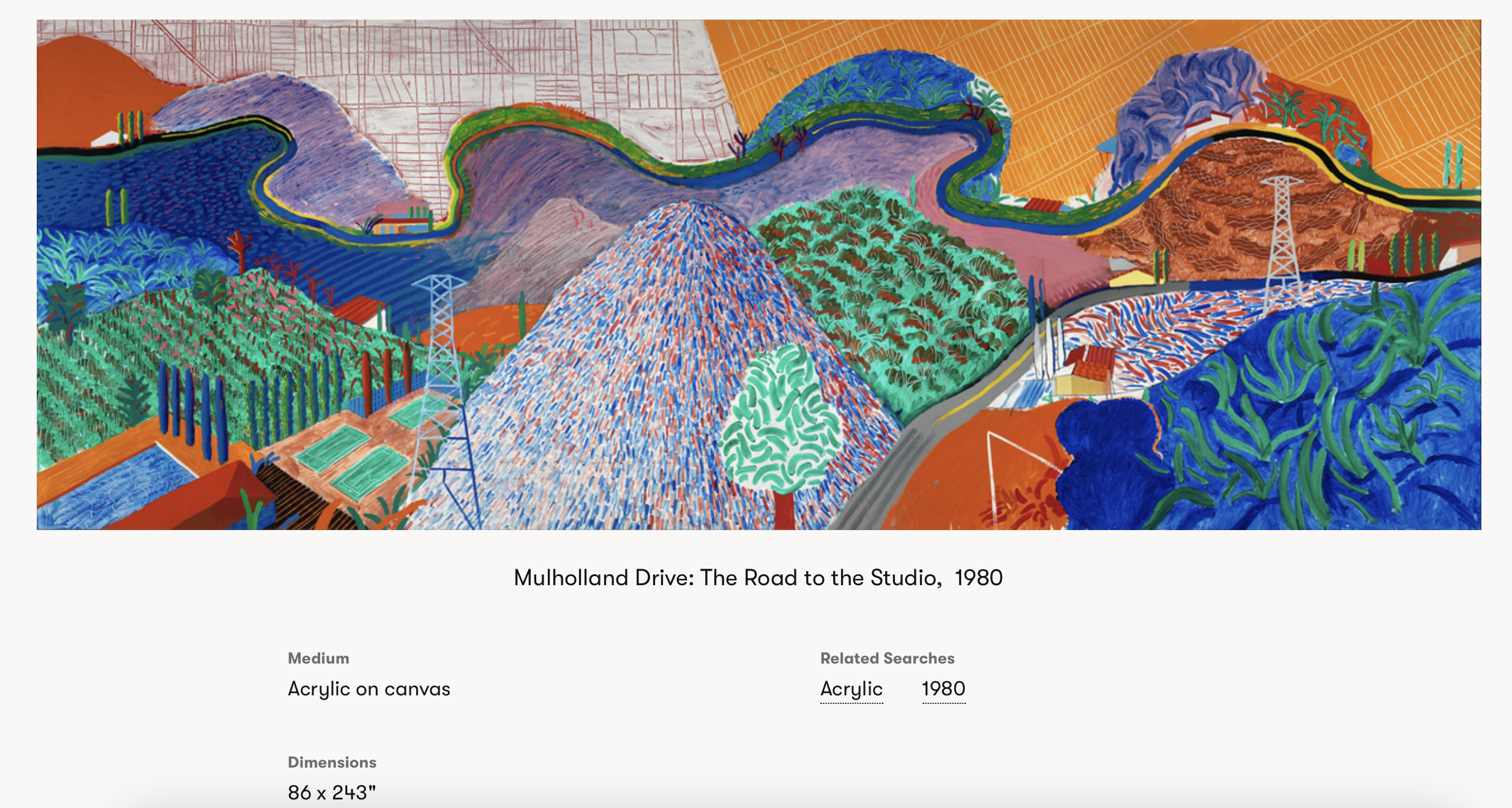
David Hockney, Mulholland Drive: The Road to the Studio, 1980, Los Angeles County Museum of Art, Purchased with funds provided by the F. Patrick Burns Bequest, photo © Museum Associates/LACMA
About mulholland Drive: the road to the studio, 1980
Painted from memory in just a few weeks, Mulholland Drive: The Road to the Studio (1980), the largest of Hockney's canvases, vividly captures the quintessential Los Angeles activity: driving. It is a personalized panoramic map of Los Angeles based on the artist's daily trip from his home in the Hollywood Hills to his studio on Santa Monica Boulevard. Hockney (born 1937) establishes a sense of distance by alternating between detailed renderings of objects (trees, houses, tennis courts, and power lines) that represent sections of the landscape and more abstract planes of color or simple grids that define the outlying Studio City and Burbank. Mulholland Drive swirls across the top of the work, moving the viewer's eye from left to right and conveying the sense of motion and altitude that the artist experienced on the ridge road.
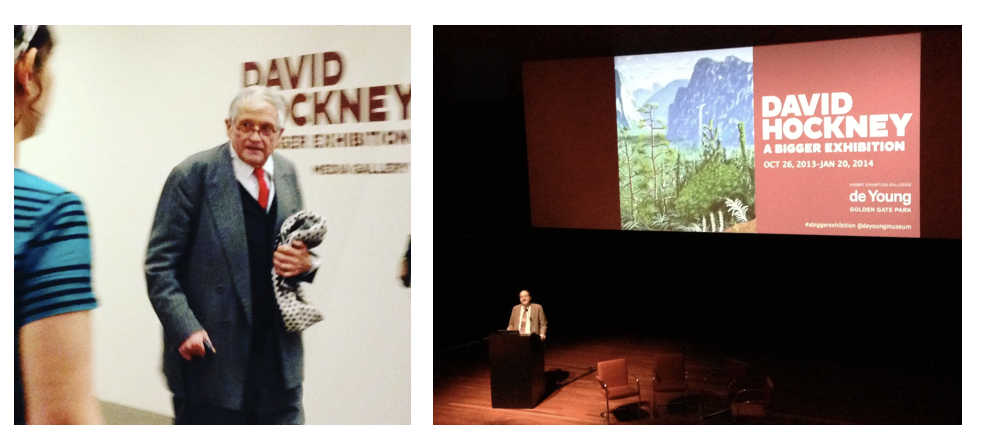
Image: SARAH WINKLER. A Bigger Picture, 2013, Hockney at his solo exhibition at the De Young Museum, San Francisco.
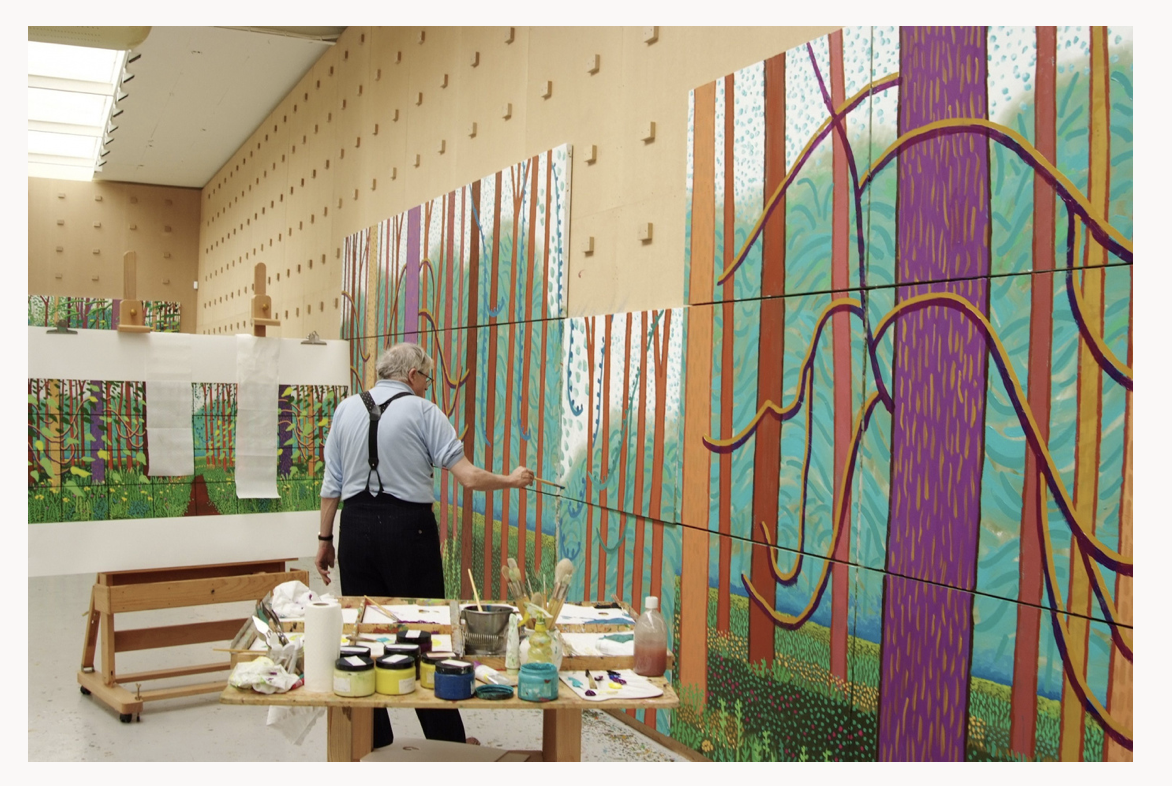
Hockney in his studio painting “A Bigger Picture” . Image credit: Hockney Foundation.
A Bigger Picture, 2013, Hockney at his solo exhibition at the De Young Museum, San Francisco.
My next encounter with Hockney was at his exhibition at San Francisco's DeYoung Museum in 2013. I was living the Bay Area at the time in an artist’s live/work space in Berkeley (Elmer Bischoff’s old studio space). It was my “MFA” of sorts not formally enrolled at Uni, but enrolled into the Bay Area art world for a few years. It was here I came within feet of the legend at the exhibition talk. He was in his late 70s. This was the first time I’d see his iPad drawings of Yorkshire in the flesh. I was skeptical if I’d like them at all. Flat digital screen art lacks a human touch I thought. But there was something extraordinary about the brushstrokes and colors. Something that resembled the lightness of watercolor painting. It was what Hockney did with this new medium that made it interesting. Zooming in/zooming out, enlarging ‘brushstrokes’ beyond their natural gestural scale. There was a gallery in particular that fascinated me most. The curator had many digital screens displaying the recorded ‘brushstrokes’ of each iPad drawing from the first stroke to the last. It was like watching over his shoulder and getting glimpse into his drawing process. A rare treat.
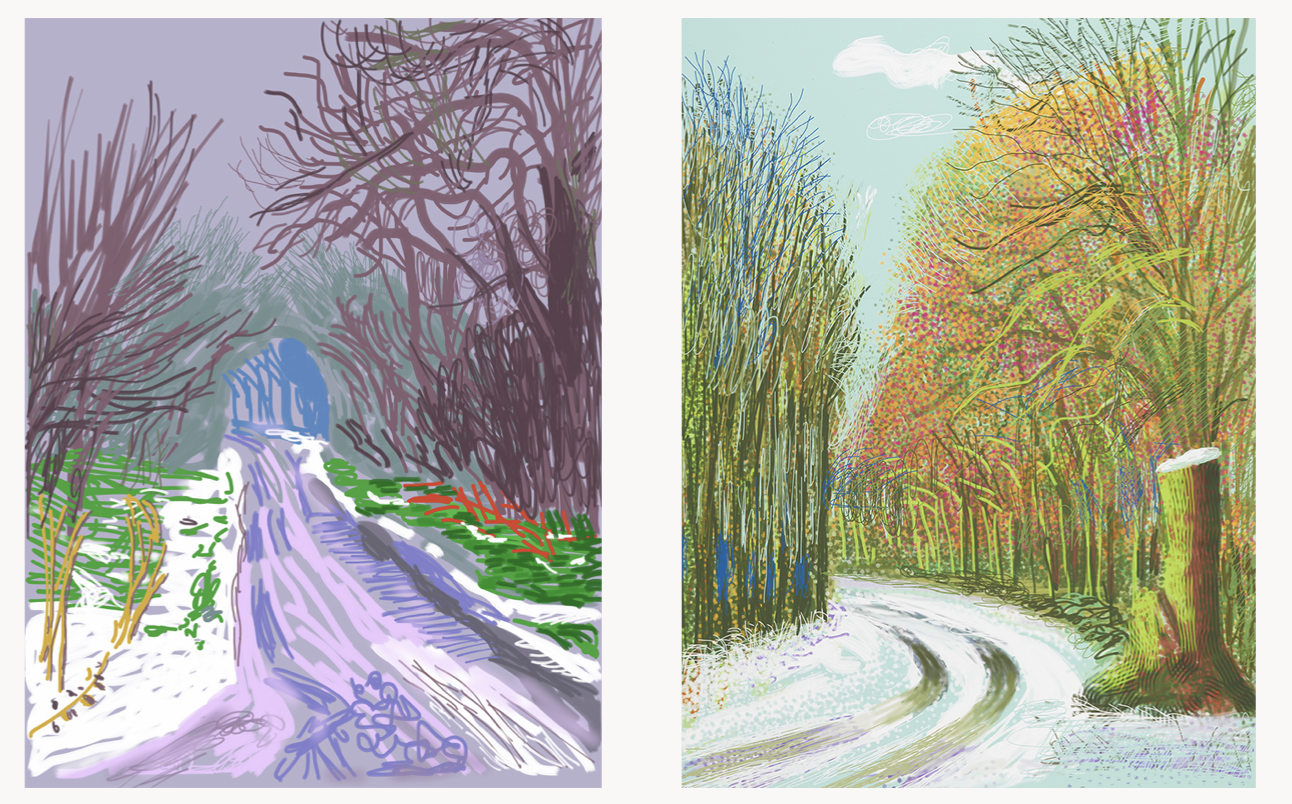
The Arrival of Spring in Woldgate, East Yorkshire in 2011, iPad drawings. Image: Hockney Foundation.
ABOUT "The Arrival of Spring in Woldgate, East Yorkshire in 2011"
A landmark iPad drawing series by David Hockney capturing the seasonal transition from winter to spring.
In 2011, after returning to his native Yorkshire, David Hockney began documenting the East Yorkshire landscape around Woldgate, focusing on tree-lined roads, light-filled woods, and rolling fields Using the iPad as his primary medium, Hockney created over 100 digital drawings en plein air, allowing him to rapidly capture the changing light and colors of early spring. The series was intended to chronicle the transformation from winter to summer, emphasizing the first leaves and blossoms appearing on trees.
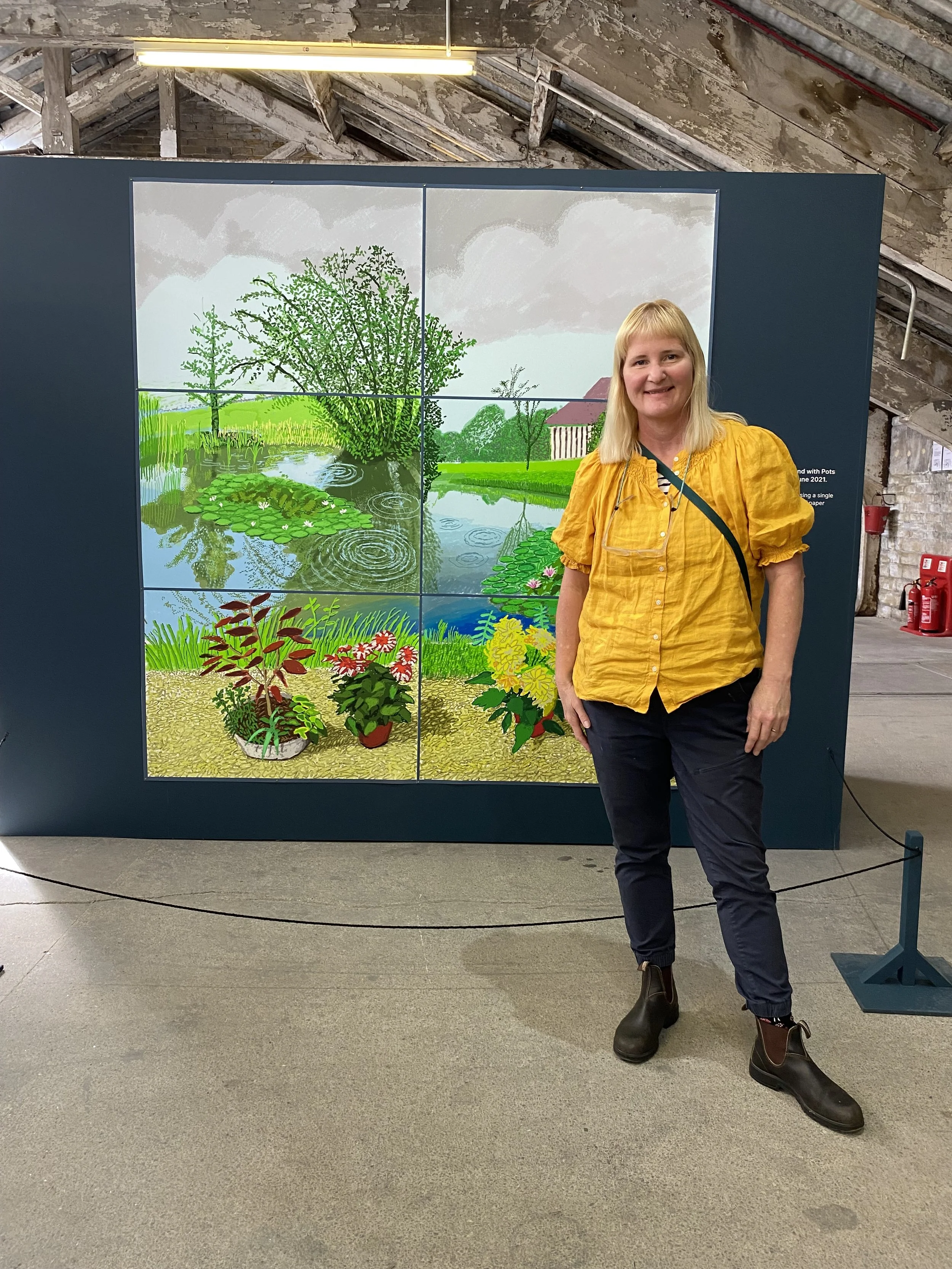
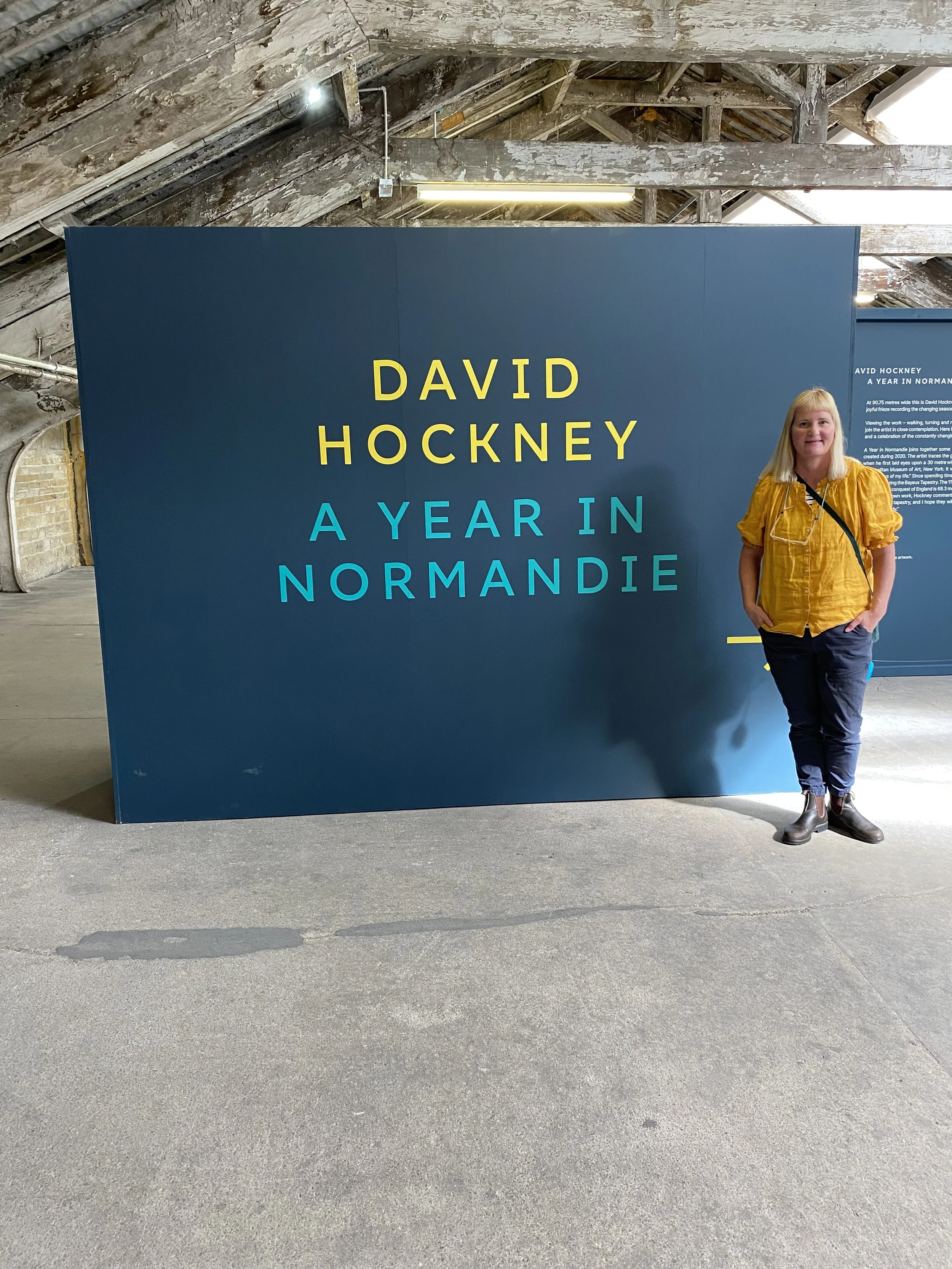
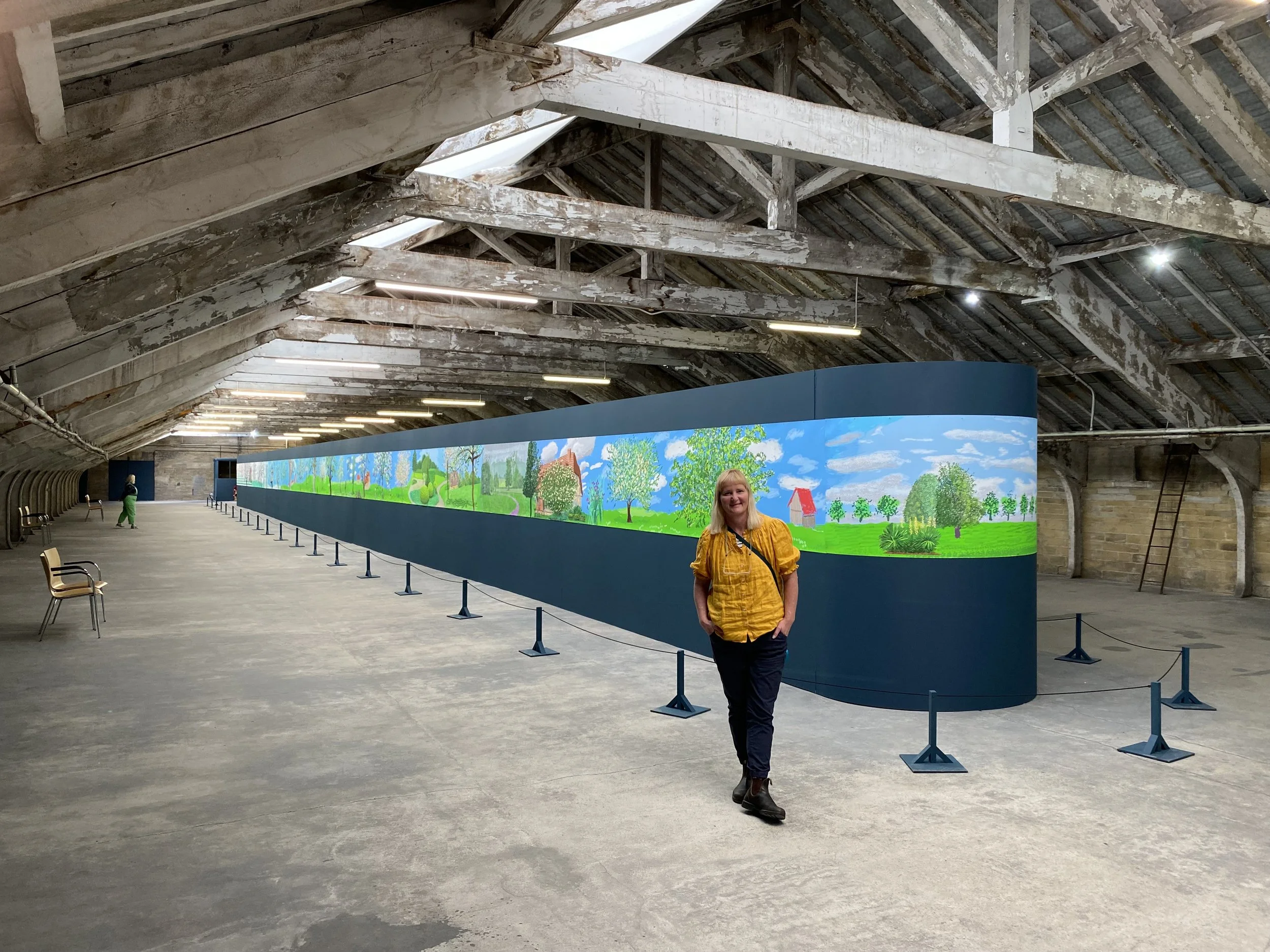
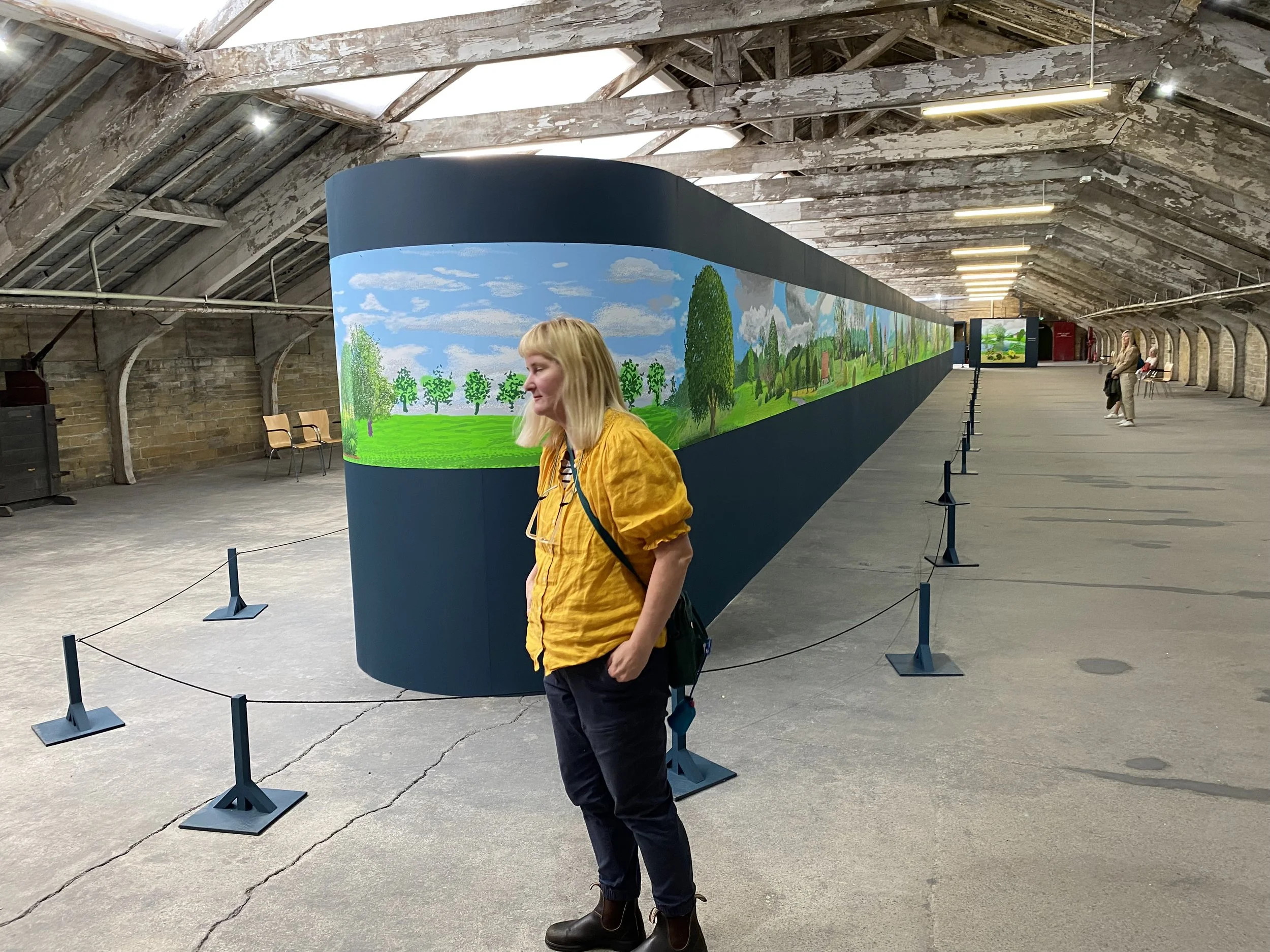
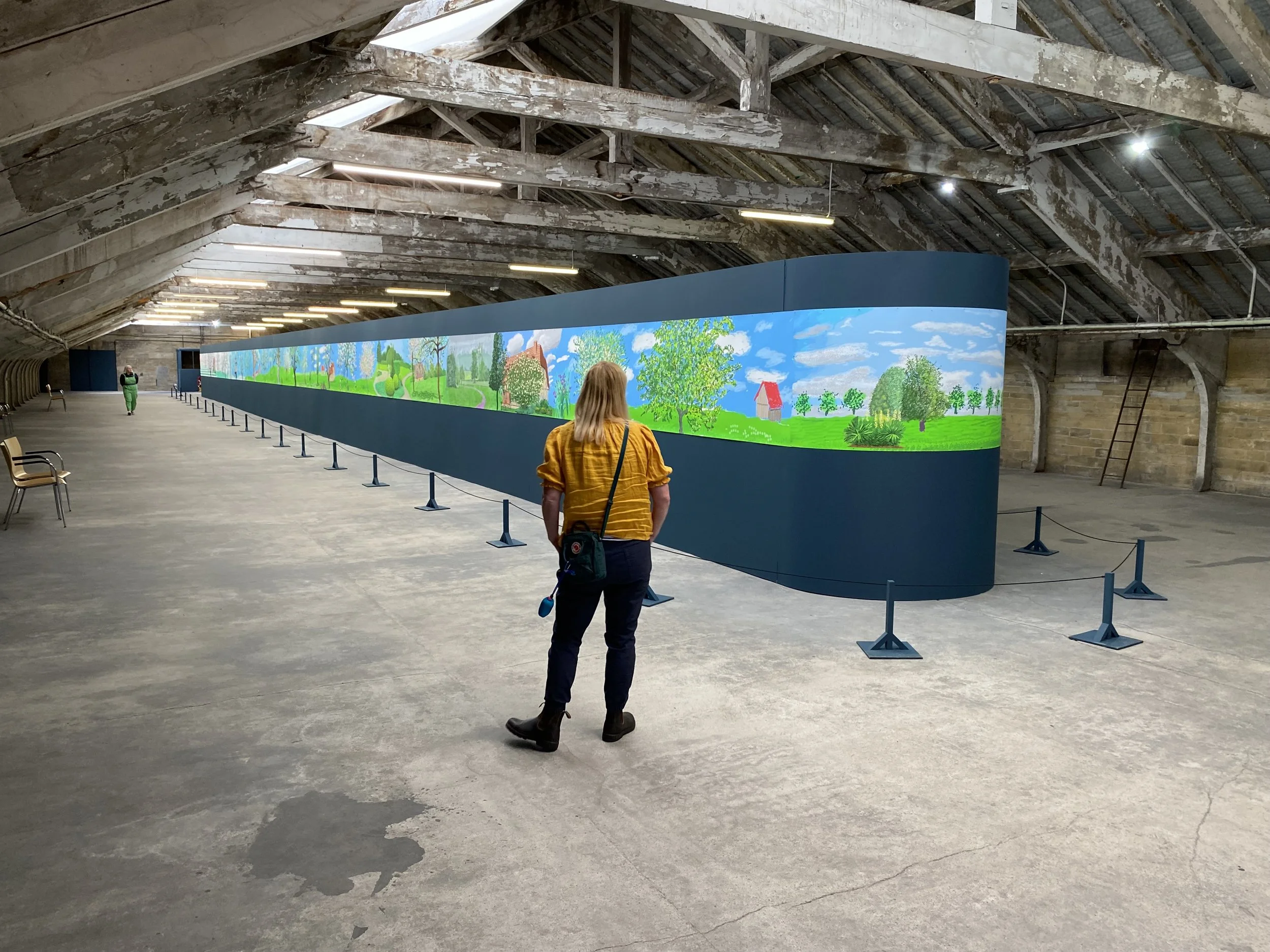
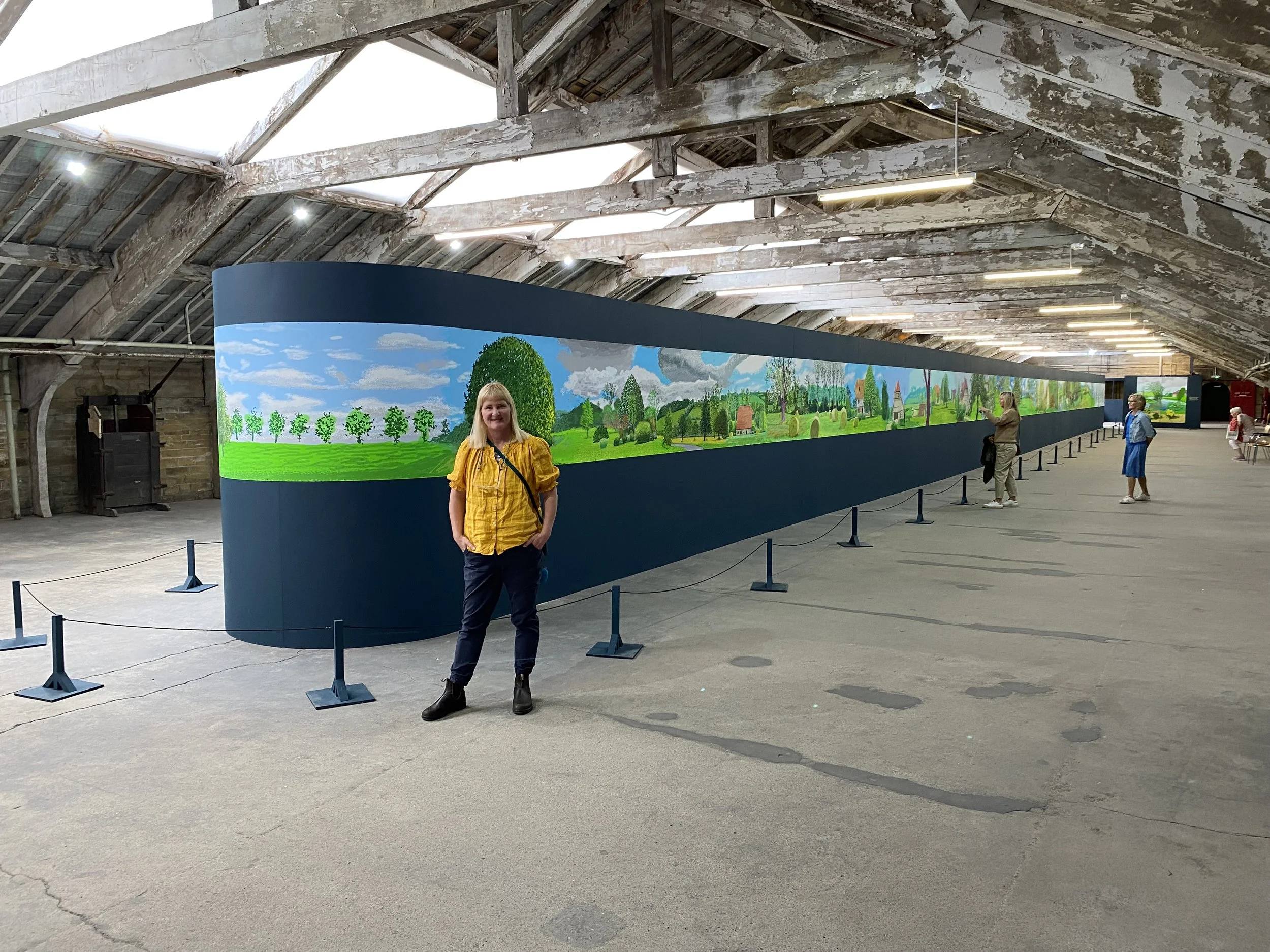
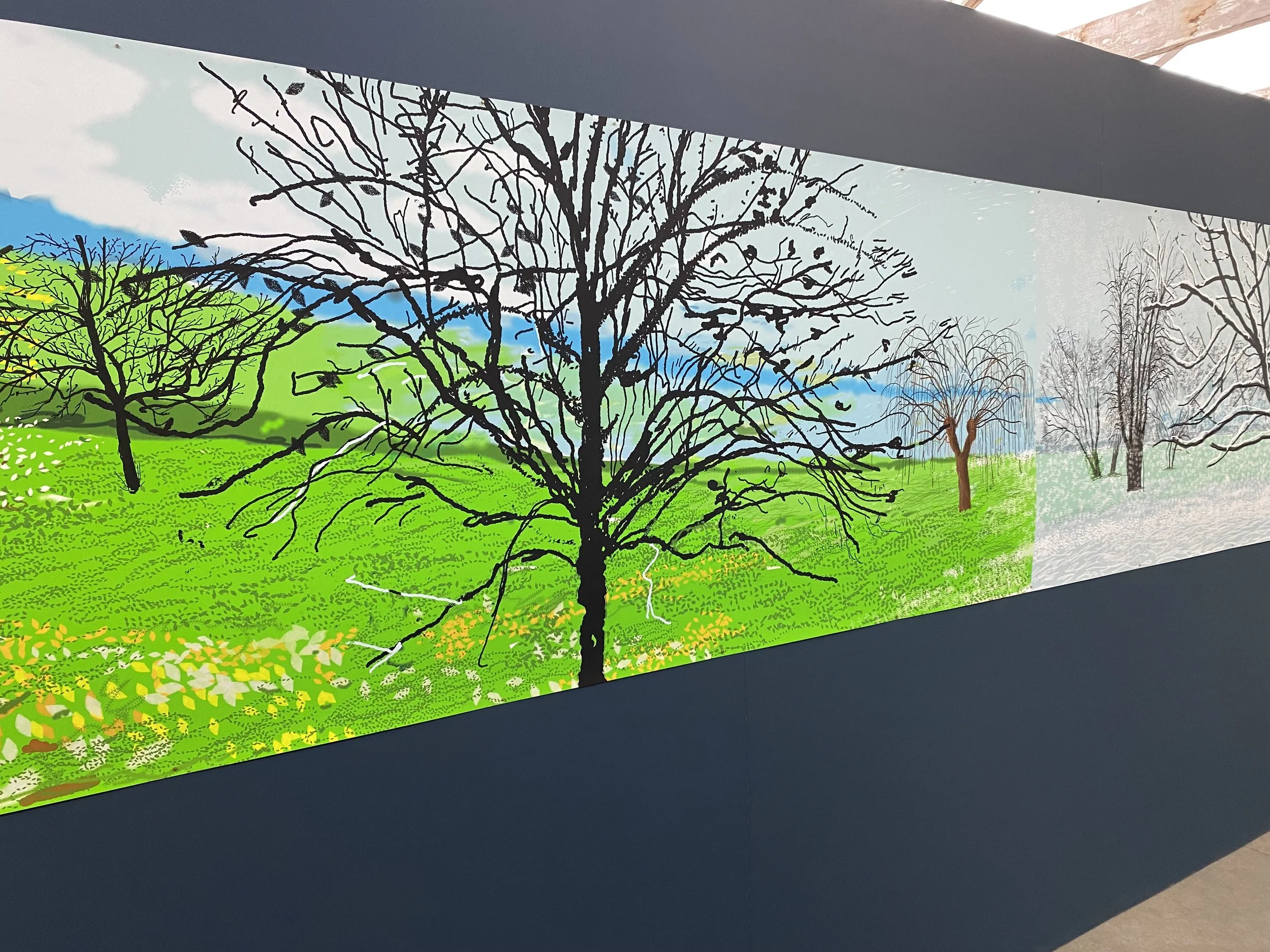
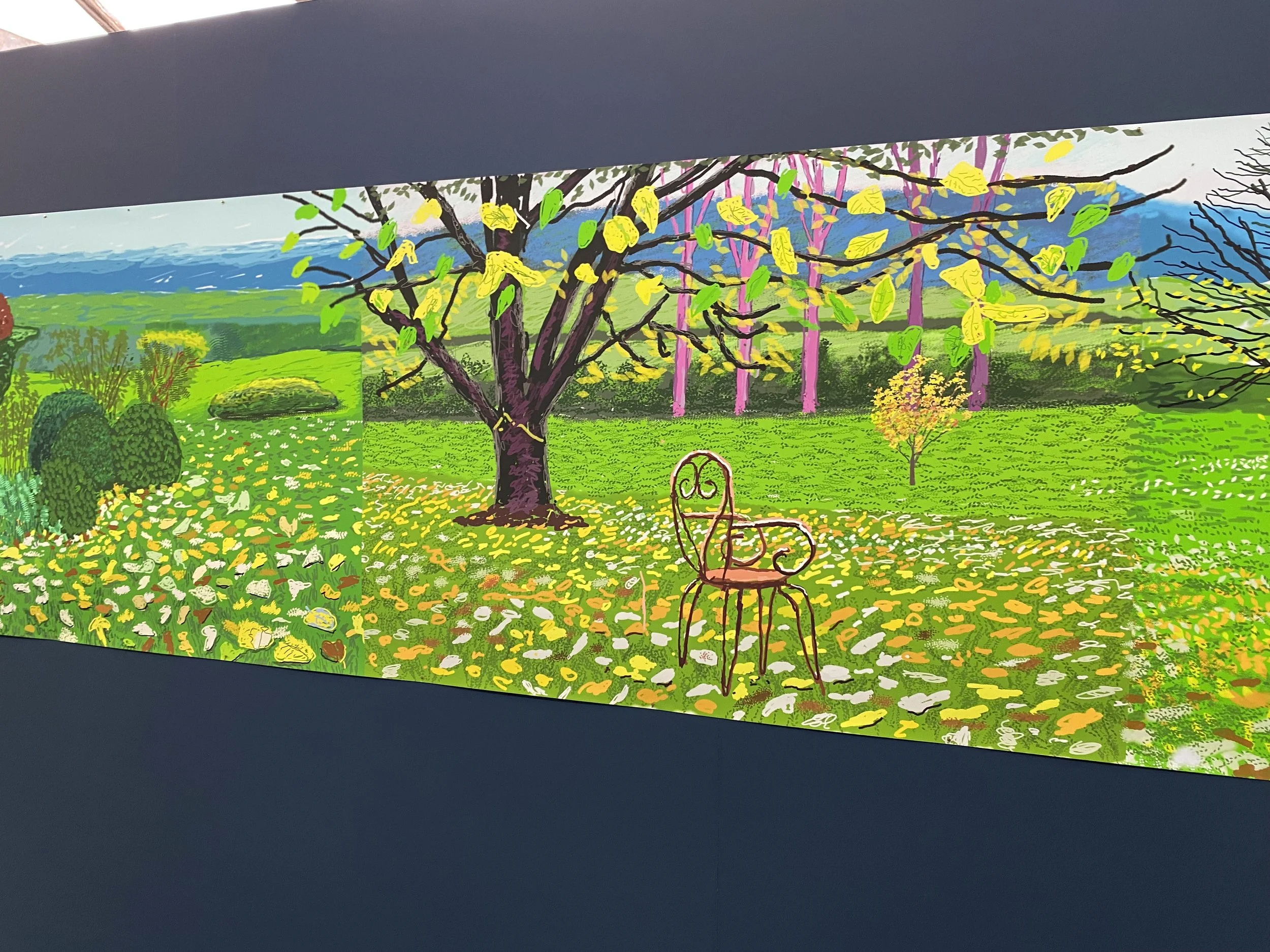
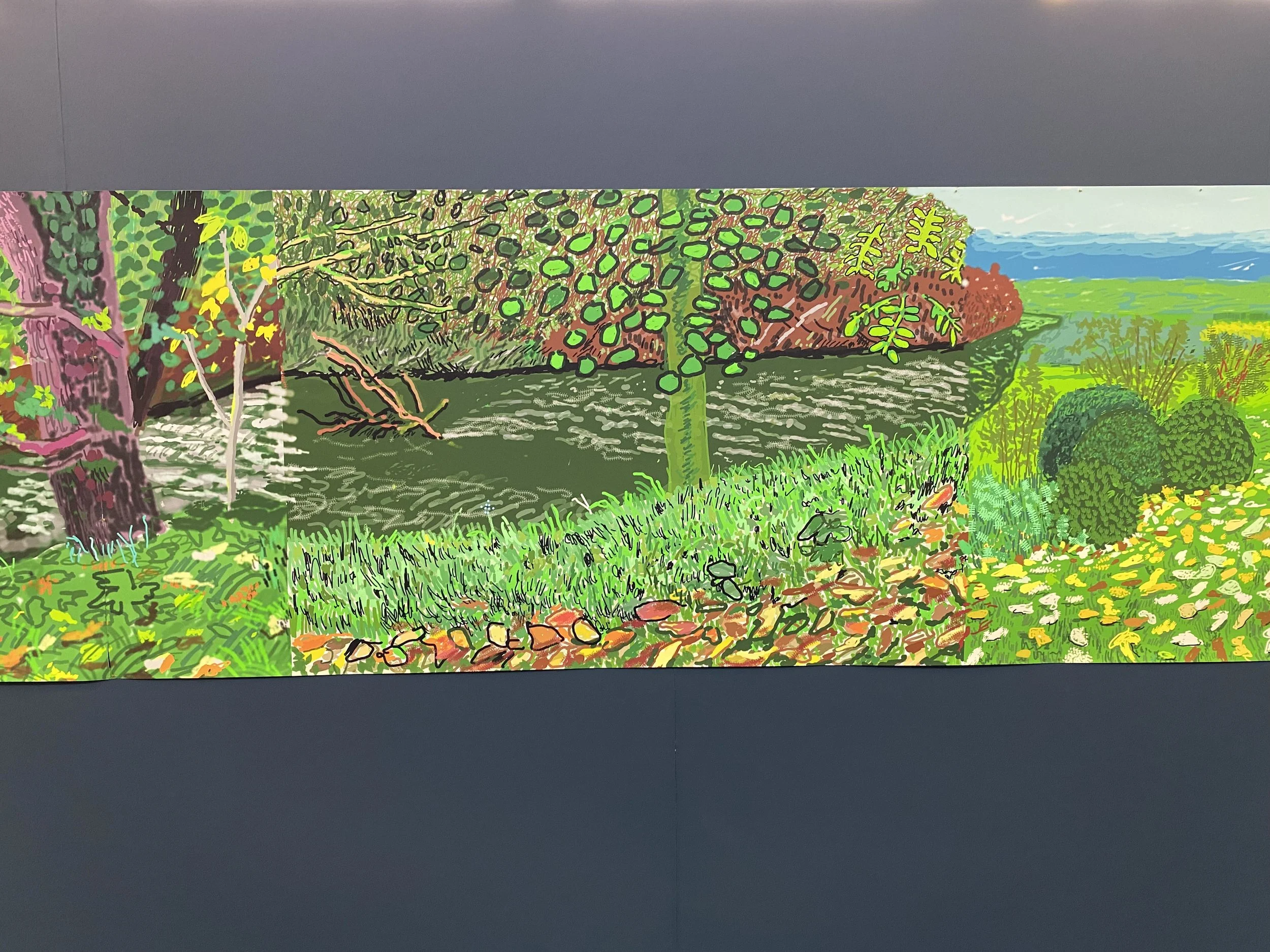
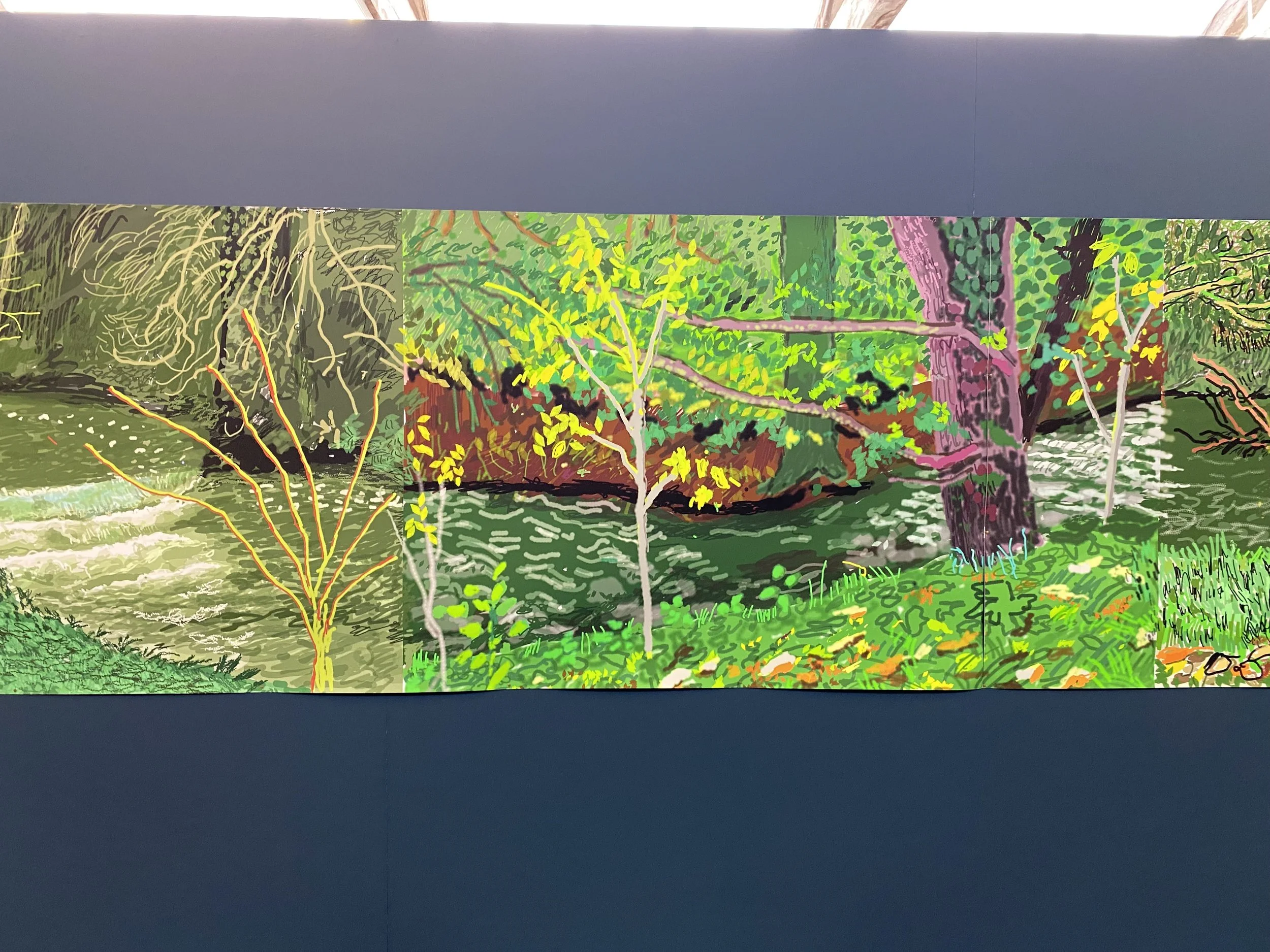
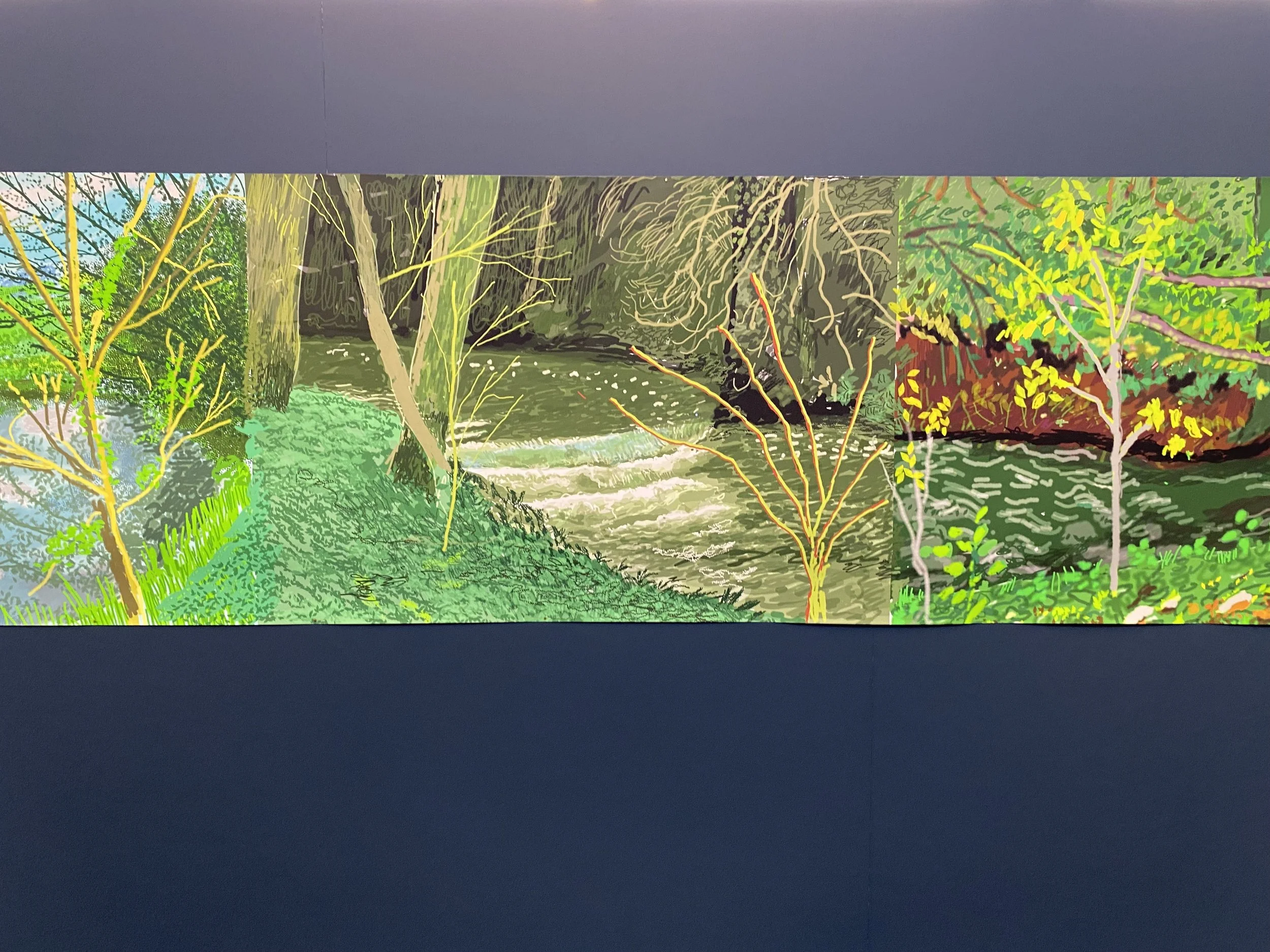
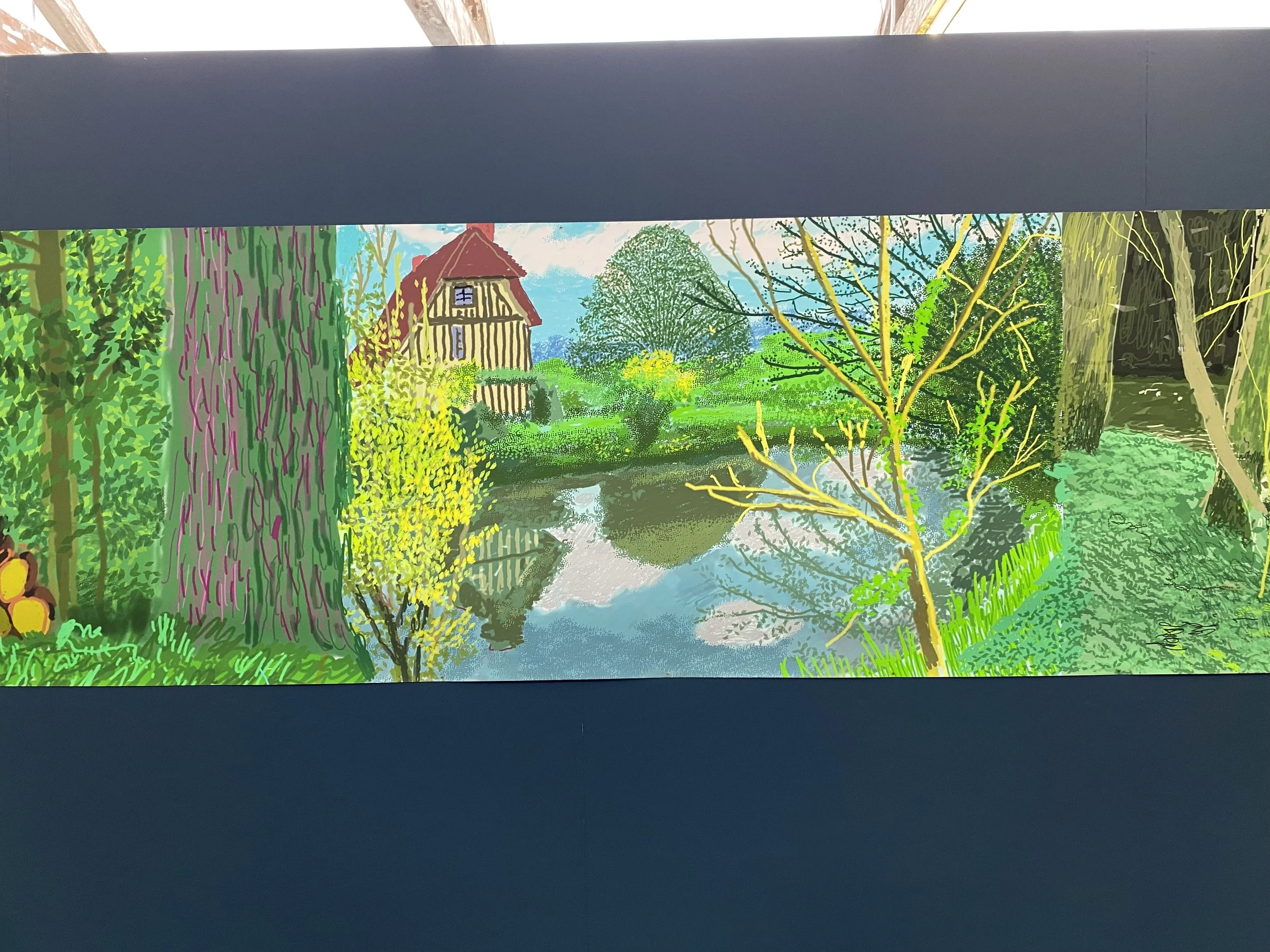
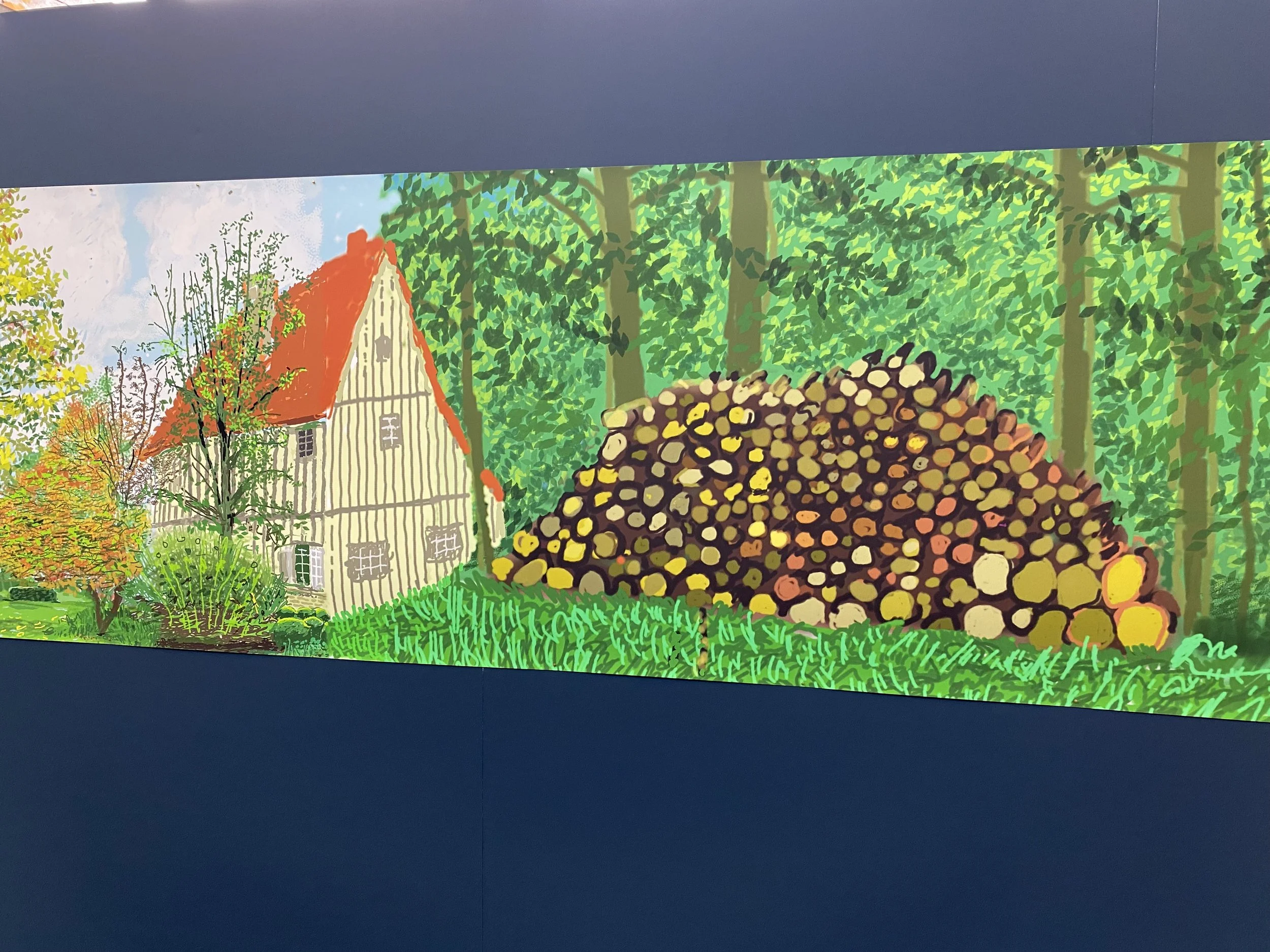
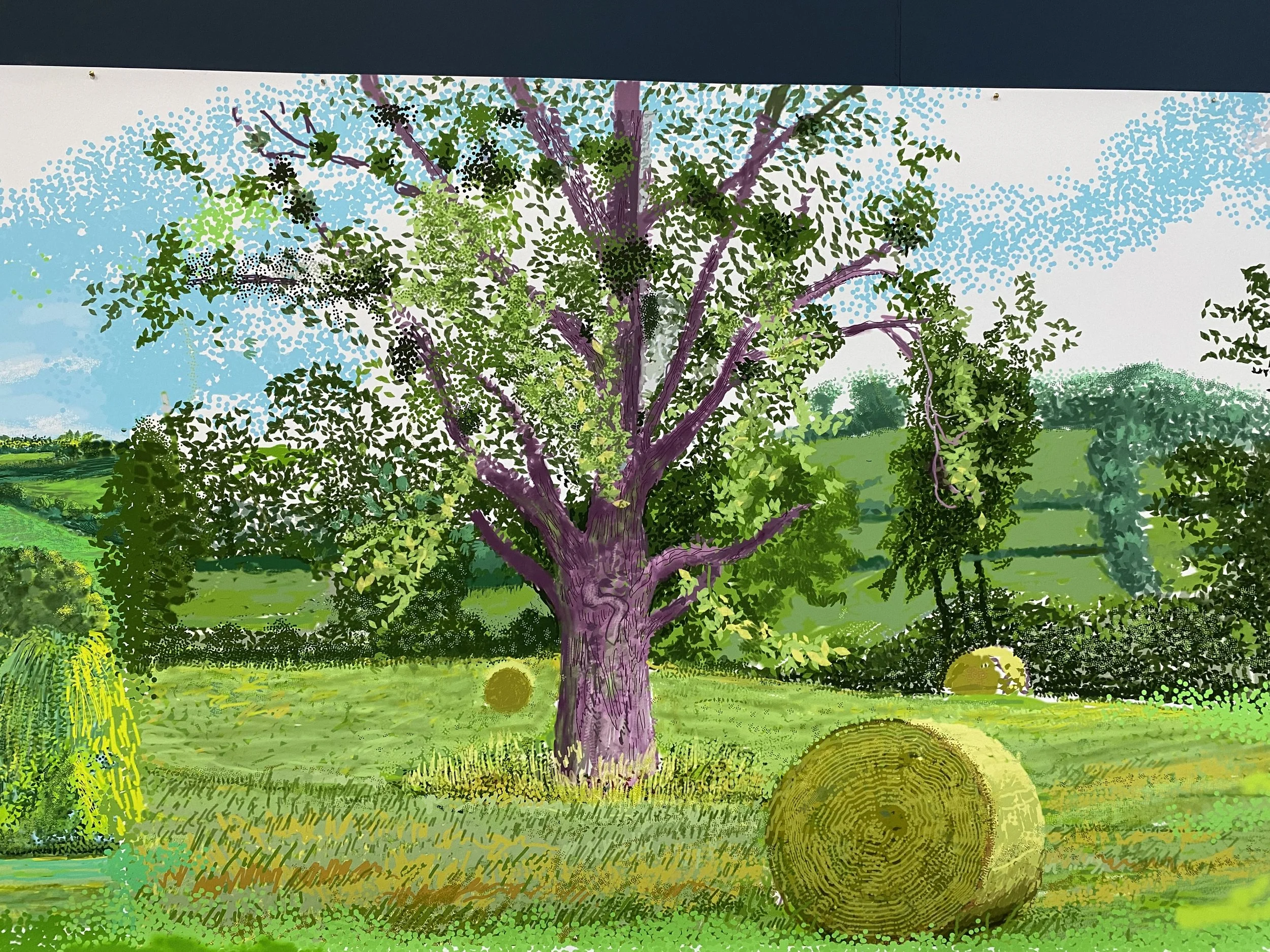
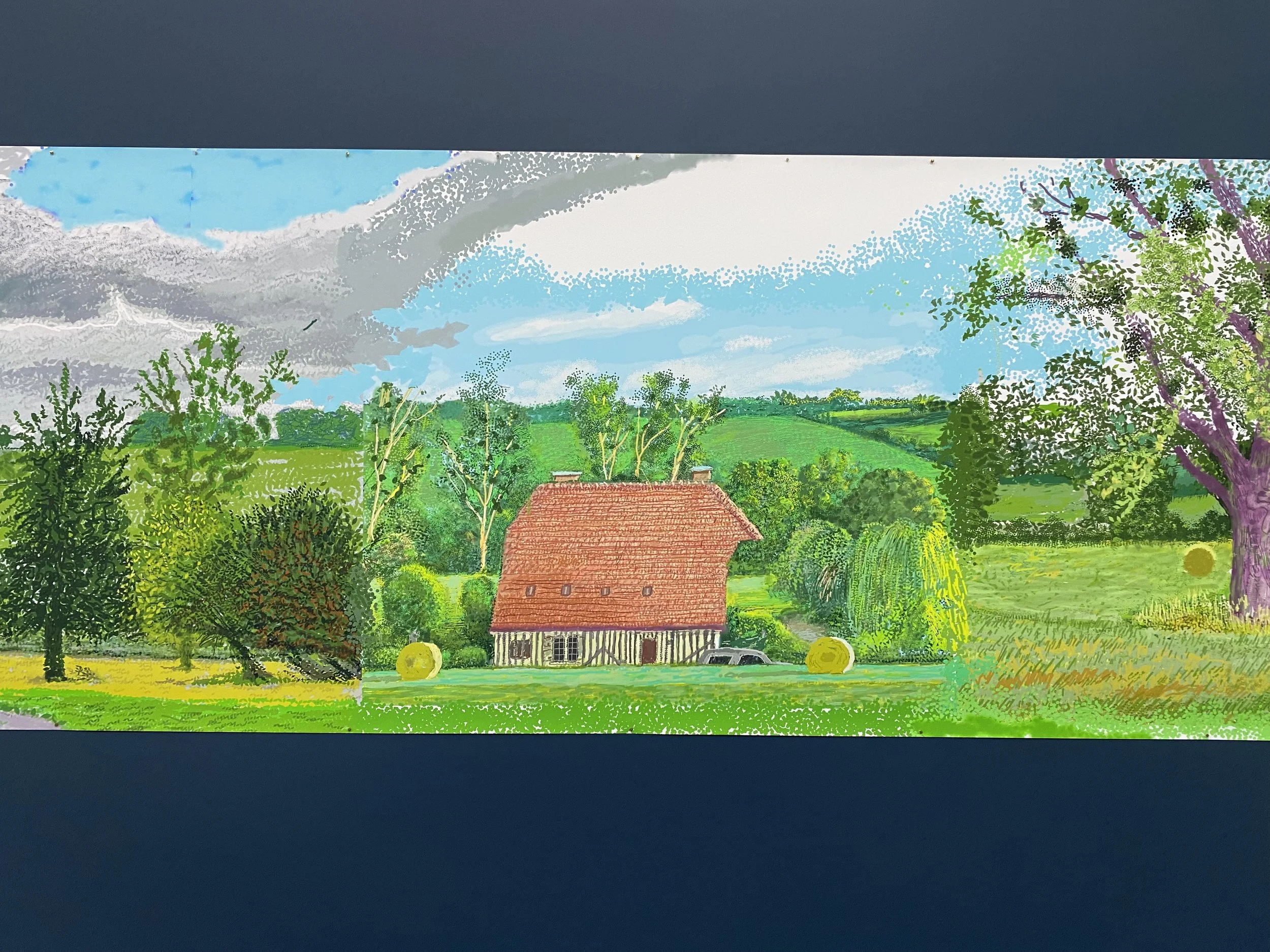
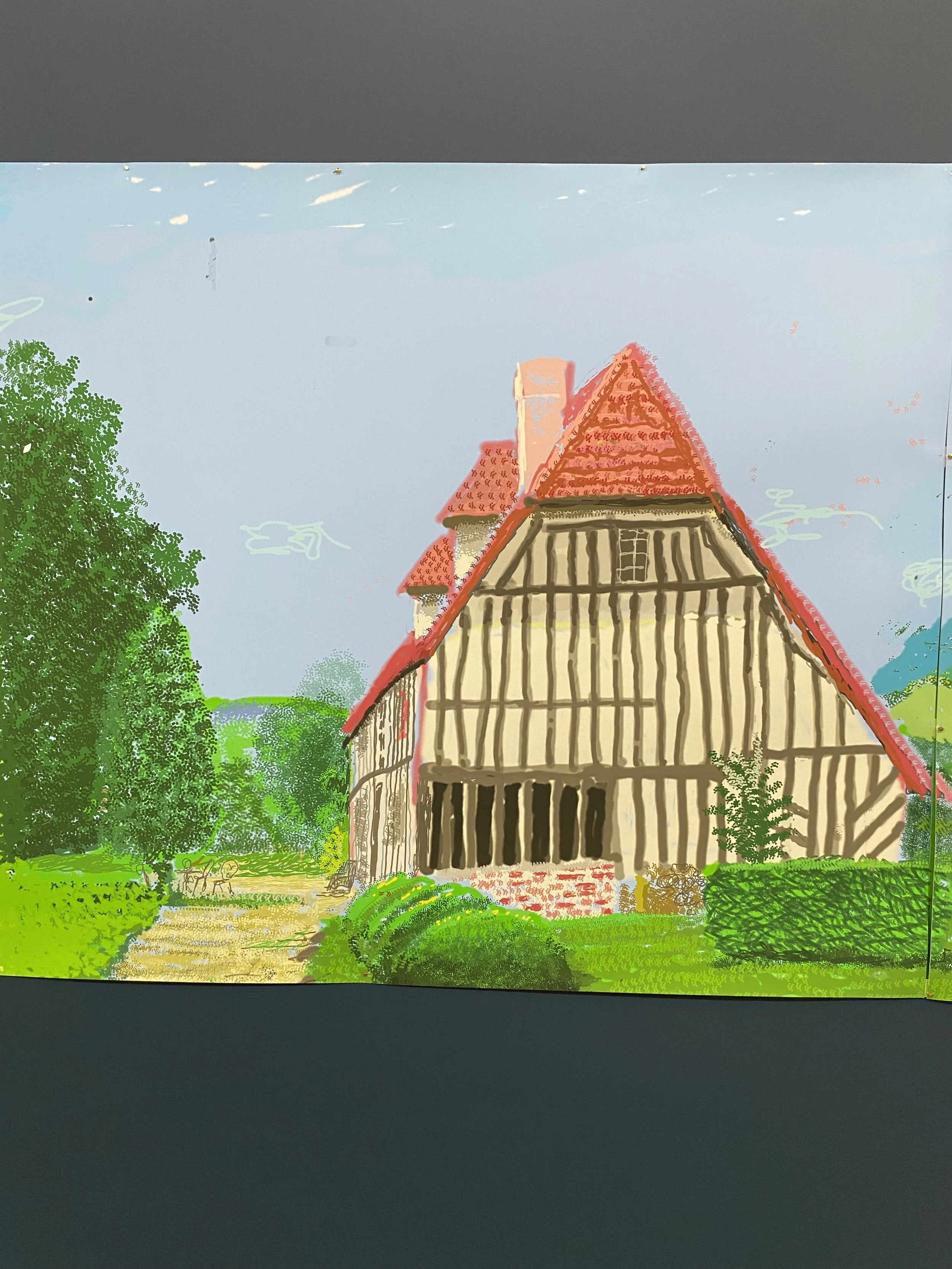
I followed Hockney for years. Amazed at his creativity and ability to surprise and delight well into his golden years. Perhaps some of his best work years coming to light in his 60s-80s. It has been a rare chance for an aspiring artist to witness a true artistic genius in his lifetime. My last encounter to date was a visit home, over the pond, to his namesake museum in the Salts Mill in Saltaire, Yorkshire. I went to see his “Arrival in Spring, Normandie’ exhibition. All iPad drawings, created during the Covid-19 lock down when he infamously declared “they can’t cancel Spring”, but this time displayed as a scroll that wrapped around an entire room on the top floor of the old mill. Again, jaw dropping see a work presented this way. A piece you had to stroll around like a walk in a garden. I jotted down these shorthand notes at the exhibition:
Hockey show - Salts Mill, Yorkshire 2023 (Sarah Winkler)
iPad- scroll presentation of a 4 acre landscape over a one year period. Hockney’s Normandy, France ‘lock down’ home. Landscapes from a distance - up close - Abstract Textures - repeated drawing strokes using digital ‘brushes’ that act like linocut stamp like marks within a color field form. Sense of depth using scale and value, saturation, light and soft to sharp and intense. Small to large. Fields of pattern repeating. To make a form like a tree. A sensation of 3-D through warm to light, light to dark. Pointillism. An area of landscape via diff angles POV over four seasons. Not same comp in diff seasons.
ABOUT David Hockney’s “A Year in Normandie”
His largest ever artwork — a 90.75‑metre‑long frieze created in 2020 using iPad drawings, printed onto paper, and displayed in a continuous run. It captures the changing seasons in and around a French garden over the course of a year, inspired by Hockney’s 2019 move to Normandy and his fascination with the region’s light, landscapes, and Impressionist heritage
There is so much more I could say about Hockney and his work and share all of my favorite pieces of his, but for now, I just want to share how much I’ll miss seeing whatever new pieces he was about to make. The way he depicted the world around him was unique, innovative and imaginative. He presented an avenue for the way artists could paint in the future. He challenged the contemporary ‘bossy’ trends in art that come and go. He remained on course and true to the lineage of great artists and the thoughts and ideas that propel the ancient craft forward. He loved life and making art.
Rest in paradise, David Hockney.